Fully automatic wire tying machines differ in many ways from conventional winding machines.
Winding machine manufacturers have gradually shifted away from manual operation to maintain production quality. These machines have self-diagnostics for easier maintenance and multiple protection features that allow use across industries.
Although the two types differ, their basic structural design and purpose are similar. Fully automatic winding machines are common in the industry. They wind and tie different cable types, making the process more efficient and reducing labor costs. If you have questions, feel free to leave a comment. See you next time.
1. Semi-automatic winding machines
Maintenance electricians often need to make low-voltage electromagnetic coils. Semi-automatic winding and tying machines can wind small and medium motor windings, low-voltage coils and small transformers. They are compact, light and simple to operate and can store the turn count. The operator straightens and spaces the wire evenly and reads the turn count from the electronic counter.
When using an automatic winding and tying machine, keep the following points in mind.
(1) Secure the winding machine to the workbench.
(2) If the counter does not start at zero, record the starting count and subtract it after winding.
(3) Use the handle to keep the wire straight and taut, but avoid pulling hard enough to break it.
2. Automatic winding machines
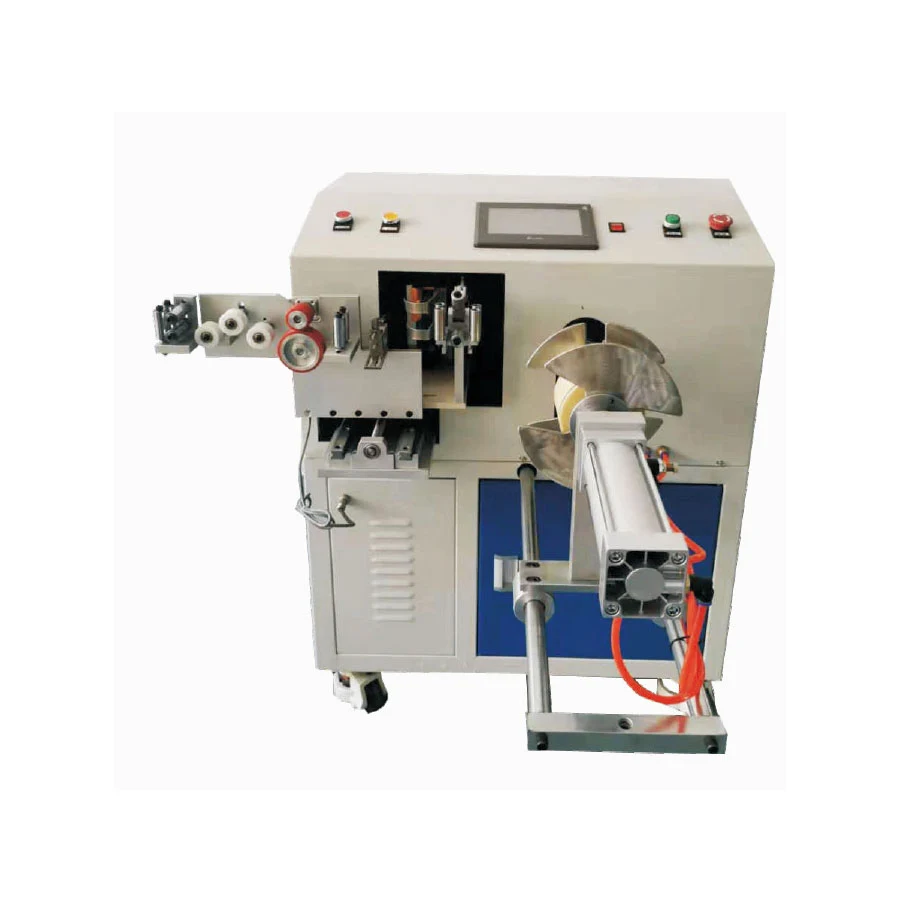
Automatic winding and tying machines have a five-digit turn display with selectable resolutions of one turn or one-tenth of a turn. They support relative or absolute zero, single or dual start, automatic coasting-turn settings, data retention after power-off and reversible counting during manual rewind. The DC version uses a variable-speed motor with torque compensation. It runs steadily and is economical, making it suitable for inductors, small transformers, small motor stators and other coils with multiple windings.
Features of the automatic winding and tying machine:
The machine has a modern design, a well-arranged layout and a heavy, reliable body made from high-quality steel.
This model uses a multi-position CNC variable-frequency control system. It is simple to operate, requires little maintenance and has a low failure rate.
The variable-frequency drive runs quietly, and the constant-current drive for the wire traverse responds quickly and accurately. Branded components offer good performance and long service life in different working environments.
The controller can store up to 1,000 program steps and set turn count, winding width, wire diameter, direction and speed. It provides accurate counting, power-loss memory, overload and overcurrent protection, and resistance to interference.
3. Fully automatic winding and tying machines
Fully automatic winding and tying machines count turns and can wind several electromagnetic coils at once, improving productivity in large batches. The Jishuang fully automatic winding machine uses a Taiwanese CNC winding controller and an AC motor with variable-frequency speed control. It lays wire evenly and neatly, delivers stable performance and offers an economical option for customers with different requirements.